Insight
The complete guide to automated food waste tracking
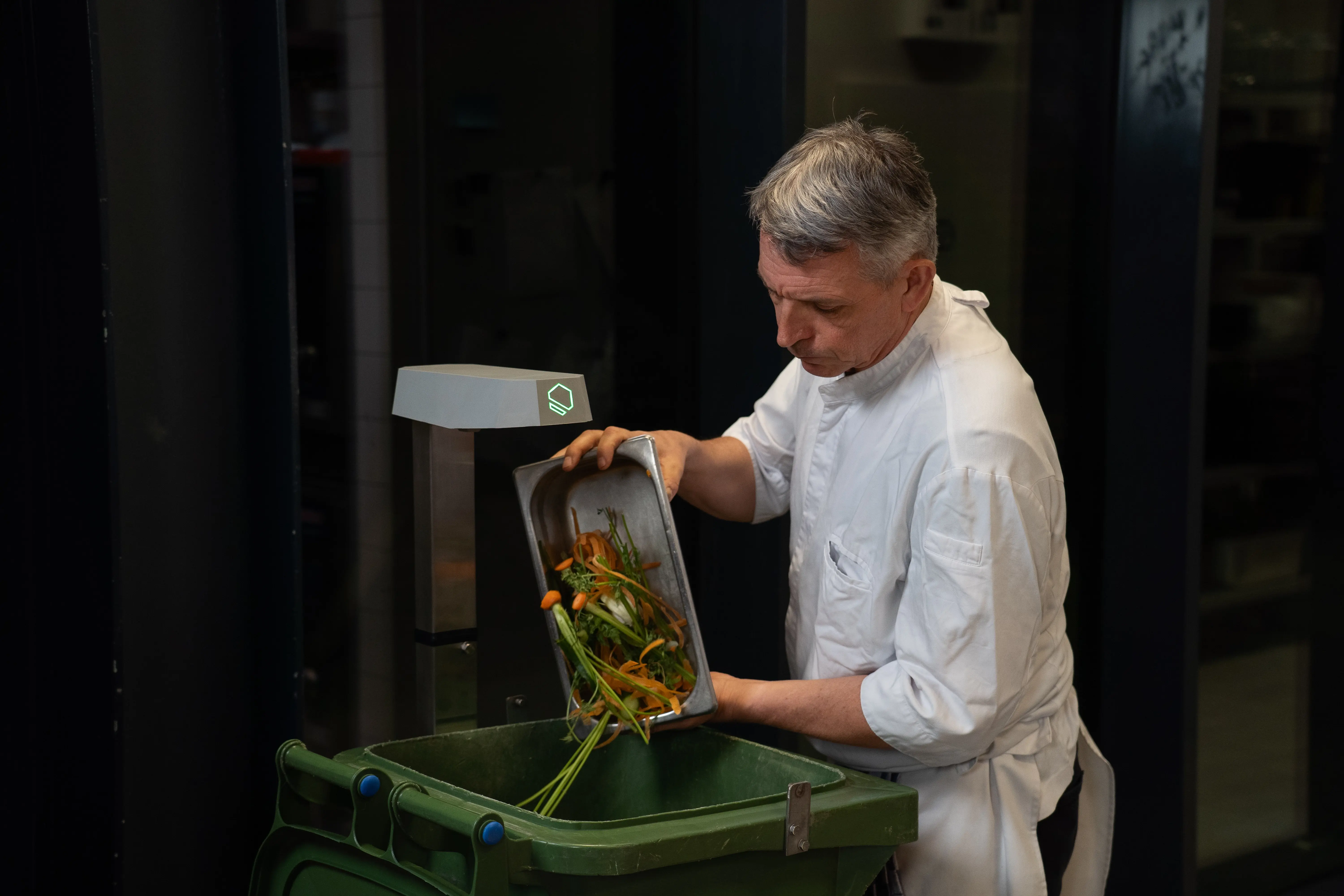
Automated food waste tracking uses a scale and a camera fitted to a kitchen bin to record what gets thrown away, how much it weighs, and what it costs. AI image recognition labels each item, and the data goes to a dashboard the kitchen team can review and act on. For commercial kitchens, the systems that work best ask nothing extra of staff and come with a person who helps the team act on what the data shows. This guide explains how the technology works, what kinds of systems are on the market, how to compare them, and what to expect in waste and cost savings. It is written for chefs, F&B directors, sustainability leads and operations managers in hotels, restaurant groups, contract catering and canteens.
Why commercial kitchens are measuring food waste now
Food service is one of the biggest sources of food waste in the world. The UN Environment Programme’s Food Waste Index Report 2024 found that food service wasted about 290 million tonnes of food in 2022, or 28% of the total. In the US, ReFED reports that restaurants and food service businesses created 12.5 million tons of surplus food in 2024, and 9.73 million tons of it went to landfill.
For an operator, that waste is money in the bin. When Pestana Hotel Group started measuring their waste with KITRO, each property saved an average of €42,110 a year. For MHP Hotel AG it was €42,690 per property. Food cost is one of the biggest lines in any kitchen budget, and waste is one of the few parts of it you can cut without the guest noticing.
Regulation is adding pressure too. The EU’s revised Waste Framework Directive came into force on October 16, 2025. It sets a binding target to cut food waste per person by 30% by 2030 across retail, restaurants, food services and households, measured against the 2021–2023 average. Member states have 20 months to write it into national law. At the same time, hotel groups and contract caterers are being asked for property-level food waste figures in their ESG reports, and estimates don’t hold up well in an audit.
Most chefs have a good sense of where their waste comes from. But once they measure it, the data usually shows a few surprises, and those surprises are often where the biggest savings are.
Manual logging vs automated waste logging
For a long time, the standard way to track food waste was a paper log or a spreadsheet next to the bin. The US EPA still offers free versions of both, and they are a reasonable place to start if you have no budget.
The problem is what happens during service: A manual log asks staff to stop, weigh the item, write down what it was and why it was thrown out. That works just fine on a quiet afternoon – not so much during a 300-cover dinner or a canteen lunch rush. And then? Entries get skipped, guessed or just filled in at the end of the shift from memory.
That creates three problems:
Gaps in the data. The busiest services, where the most waste happens, are the ones most likely to be missing.
Training and staff turnover. High turnover requires constantly training new staff on logging routines. When training falls through, new team members guess or skip entries, making the dataset unreliable
Lost time. Weighing and recording waste manually during service takes cooks away from the stove. In KITRO’s Marriott International case study, properties saved an average of 1,096 staff hours per year each simply by eliminating these manual steps.
Automated waste tracking captures the weight and an image of each item as it’s thrown away. With no manual step to interrupt service, kitchen teams stay focused on preparation and service, and the data stays complete even on the busiest shifts.
How automated food waste tracking works
Most automated systems follow the same basic steps, even if the hardware works differently.
1. Capture
A scale under the bin records the weight of every item that goes in. A camera, mounted on a pole or wall above the bin, takes an image of the waste. Some systems capture the image as food is presented to the camera or tracker. Others, like the KITRO TARE, take the image of what has landed inside the bin.
2. Identify
AI image recognition compares the image to a library of known food items and labels what was thrown away: rice, bread rolls, salmon trim, a tray of roast potatoes. Good systems also separate edible food waste (food that could have been eaten) from inedible parts like bones, peels and shells. That split matters, because edible food waste is the part you can reduce.
No AI-based image recognition is right every time. The question is what the system does when it isn’t sure. Some treat every AI guess as final. Others, including KITRO, send uncertain items to a person to check before the data reaches your dashboard.
3. Put a value on it
The system turns weight into cost using your purchase prices, and into CO₂ using standard emission factors. Converting waste into exact financial costs and carbon emissions turns an abstract idea into a clear, measurable line item on your budget.
4. Show the patterns
A dashboard and, for some solutions, regular emails show what is being thrown away, at which station, during which service, and how often. The most actionable insights are usually specific: “We throw away about 4 kg of bread rolls after every Sunday brunch” or “Rice waste doubles on days with under 150 covers.”
5. Act and measure again
The data points to changes: smaller batch cooking, a different par level, a new use for trim, a menu tweak. You make the change, the system keeps measuring, and you see whether it worked against your baseline.
Step 5 is where most of the savings come from, and it is also where many kitchens struggle. A dashboard on its own doesn’t reduce waste. That is why the people behind the system matter as much as the hardware (more on this below).
Types of food waste reduction technology for commercial kitchens
Here are the main types of food waste management systems available today, from least to most automated.
Paper or spreadsheet logs
Staff weigh each item and write it down. It takes the most staff effort of any option. It’s a fair starting point for a small kitchen that wants to test the idea with no budget.
Scale plus tablet
Staff put the waste on a scale and pick the item on a touchscreen. The effort is medium, so it works best at single sites with a stable, motivated team.
Photo-before-disposal cameras (semi-automated)
A camera mounted above the bin takes a picture of the food before it goes in, and a scale weighs it. To get a usable image, staff hold the plate, tray or container under the camera for a moment and wait for it to register before tipping it into the bin. It’s a short pause, but it comes with every single throw.
Plate and tray waste systems
A camera or scale sits at the dish return. Staff effort is low, and guests do nothing different. Canteens, schools, hospitals and buffets use these to measure what guests leave on their plates.
In-bin cameras (fully automated)
Here the bin sits on the scale and the camera looks down into it. Staff throw food away as they always have, and the system records what has landed in the bin, with nothing to hold, wait for or confirm. Because capture doesn’t depend on timing, it keeps working during the busiest services. This is the best fit for busy kitchens, canteens and caterers, where any extra step gets skipped.
It’s also the approach the KITRO TARE is built on. Because it asks nothing new of the team, new starters and temporary staff don’t need training on it, so the data stays complete even when the team changes often. As Daniel Lehmann, General Manager of the Zürich Marriott Hotel, puts it: “KITRO is a plug and play with very little effort for training and understanding. It’s actually self-explanatory.”
The right type depends mainly on how much food your kitchen handles and how often your team changes. A small kitchen with a steady team can learn a lot from a few weeks of manual logs or a tablet scale. Hotels with several outlets, canteens and caterers usually need automation to get complete data, and plate waste tracking is worth adding wherever guests serve themselves or return trays. The next section covers how to tell whether a system that calls itself automated really asks nothing of your staff.
Which food waste tracking solutions require no staff interaction?
Most vendors now describe their systems as “touchless” or “zero effort.” That label can mean different things, so it is worth testing it during a demo or trial.
Ask these questions:
Does anyone need to press, tap or confirm anything? Some systems still ask staff to pick a category on a screen for certain items, or have a manual mode that some sites end up using.
Does the throw need to happen in a specific way? If the camera captures food in the air above the bin, ask what happens when a cook scrapes a full gastro tray in one go, or when two people throw at the same time. A camera that looks at what is in the bin doesn’t depend on timing.
Is there a screen on the unit? A screen can be useful for feedback, but it is also one more thing to clean and maintain in a wet, busy area.
What happens when the AI isn’t sure? If uncertain items go straight into the data, errors build up over time. If a person checks them, your numbers stay reliable.
What happens when the Wi-Fi drops? Kitchens are hard places for Wi-Fi. Ask whether data is stored locally and uploaded later, or lost.
The KITRO TARE was built around these questions. The bin sits on a scale, the camera captures what lands inside it from above, and there is no screen to use. Staff throw food away as they always do. When the AI isn’t confident about an item, a person checks it before it enters your data. Every TARE is monitored and rebooted overnight, and data is stored locally if the connection drops. The result is a full data set without training or reminders, including during the busiest services.
Food waste tracking for canteen operations
Canteens and staff restaurants have a few traits that make food waste tracking harder than in a hotel kitchen:
Most waste happens in a short lunch window of one or two hours, when nobody has time to log anything.
Staff turnover is high and many sites rely on temporary staff. Any system that needs training loses accuracy every time the team changes.
A lot of waste comes from overproduction on the serving line. Knowing which dishes are left over, and on which weekdays, is where most of the savings are.
Guests leave food at the tray return too, and that plate waste tells you a lot about portion sizes and menu choices.
What works best for canteen operations, whether in hospitals, schools, universities or corporate cafeterias, is a system that asks nothing of the team and automatically links waste to the number of meals served. Waste per cover (grams of waste per meal served) is the most useful metric here, because it lets you compare a busy Monday with a quiet Friday.
In a Champions 12.3 study, 86 catering sites in six countries using smart scales or a similar system to measure food waste cut their food waste by an average of 36% within a year. Most spent less than $10,000 over three years on scales, training and menu changes, and nearly two thirds earned that back within the first year.
Food waste tracking for catering operations
Catering and banqueting come with their own problems. Guest numbers change up to the last minute, buffets are built to look full until the end, and overproduction is built into the business model.
The main sources of waste in catering are usually:
Buffet leftovers that can’t be served again
Overproduction for events where the final count came in lower than planned
Prep waste during large batch cooking
Tracking shows which dishes are over-produced most often, so you can set better quantities per guest and compare events of the same type and size. It also gives you real numbers to share with clients who ask about the sustainability of their event.
For hotels with banqueting, it is worth placing a tracking unit in the banqueting kitchen as well as the main kitchen. Buffet and event waste often behaves very differently from à la carte waste.

How to evaluate food waste management systems
Once you’ve seen a few demos, most systems start to look alike. The ones worth shortlisting give clear answers to what staff have to do each time food is thrown away, how the data is checked before it reaches your dashboard, and who helps you act on it once setup is done.
For the full list of criteria, from hardware and multi-site views to integrations and contract terms, plus the questions to bring to every sales call, see our buyer’s guide to food waste solutions for hotels and restaurants.
Why expert support matters as much as the technology
Data on its own doesn’t reduce waste. A chef at one KITRO customer put it plainly: “you have to work with the system, otherwise it’s just a camera.”
The kitchens that get the biggest reductions follow a pattern of seeing, thinking and acting. They look at the data together, talk about why the waste happens, agree on one or two changes, and check the next week whether it worked. When staff see the numbers for the first time, a common reaction is “I wouldn’t have thought that.” Chefs we work with describe it as a way to learn, and it works best when it is framed that way rather than as a control tool.
Support from outside the kitchen helps here. Someone has to read the patterns and decide what is worth fixing first, and the fix has to be realistic for that kitchen's service style and pace. Then someone needs to follow up so that what was agreed actually happens.
This is why KITRO pairs every customer with a dedicated food waste expert. The expert reviews your data with you, runs regular guidance sessions and suggests specific changes that fit how your kitchen runs. KITRO customers can also use KITRO's food waste benchmark data to see how their kitchen compares with similar operations.
When you compare vendors, ask who your contact will be after setup, how often you will speak, and what they will bring to each session.
What does automated food waste tracking cost, and what does it save?
Pricing varies a lot between vendors. Most use a mix of hardware (bought, leased or rented) and a monthly or yearly software subscription. Some include coaching or expert support; others sell it as an add-on. Ask for a full price per site per year, including everything you need to get results.
The savings side is better documented. Independent research by Champions 12.3 found that:
Hotels saved $7 for every $1 invested in reducing kitchen food waste and cut waste by 21% on average in the first year (42 hotels in 15 countries, published 2018).
Restaurants saved $7 for every $1 invested and cut waste by 26% on average in the first year (114 restaurants in 12 countries, published 2019).
Catering sites saved $6 for every $1 invested and cut waste by 36% on average in the first year (86 sites in 6 countries, published 2018).
These studies cover all kinds of waste programmes, including manual ones. Hotel Kitchen, a partnership of WWF, the American Hotel & Lodging Association and The Rockefeller Foundation, reports that properties using tracking technology have seen food waste reductions of 50% or more. With intelligent automation and expert support combined, KITRO customers typically see:
Up to 60% reduction in edible food waste
2–8% annual food cost savings
A payback period of about six months
Results from KITRO-powered kitchens
A 2025 peer-reviewed study from the EU-funded LOWINFOOD project tracked KITRO devices in five HORECA kitchens across Germany, Switzerland and Greece. Four of them cut food waste per meal by 23% to 51%. The fifth ended up wasting more, because high staff turnover got in the way of the planned changes. The device logged everything in all five kitchens. Waste only went down where the team acted on what it showed.
KITRO’s own case studies show similar results across various hospitality operations:
Hyatt Hotels uses 79+ KITRO TARE units across Europe, Africa and the Middle East and has saved €1.7 million in total. Across 30 properties, each hotel cut edible food waste by 31% on average and saved €30,853 and 230 staff hours a year, a 365% return on investment.
Marriott International uses 56 KITRO TAREs and named KITRO a preferred partner in 2025. Across three properties, each hotel cut edible food waste by 22% on average and saved €27,390 a year, a 101% return on investment. The Zürich Marriott Hotel on its own cut edible food waste by 25% and saves €40,720 a year.
KITRO also works with big hospitals, one of which saves on average €61,523 and 873 staff hours a year, achieving a 302% return on investment.
Your own numbers will depend on your menu, covers and starting point. If you want a better idea of the savings you can expect, request your free assessment today.
How to get started
Pick one kitchen to start. Choose the site with the most waste or the most motivated head chef. A good first result makes rollout easier.
Agree on what success looks like. Pick one or two numbers: edible food waste per cover, total food cost, or kilos of waste per week.
Run a baseline. Measure for a few weeks without changing anything. This is the number you will compare against.
Bring the team in early. Share the data at a team briefing and treat waste reduction as something the whole team owns.
Make one change at a time. Fix the biggest item first, then measure again.
Roll out once it works. Use the first site's results to plan the next ones, and compare sites on one dashboard.
Frequently asked questions
What is the best tool to reduce food waste in commercial kitchens?
The best tool is one your team will use every single service without thinking about it, backed by people who help you act on the data. For most busy commercial kitchens, that means an automated AI camera and scale that needs no staff input, checks uncertain items, and comes with dedicated expert support. To see how the main systems on the market compare on these points, read our buyer’s guide to food waste solutions.
What food waste tracking technology works best for canteen operations?
Canteens need a system that asks nothing of staff during busy lunch peaks and still works when the team changes often. It should also track waste per meal served and turn it into a CO₂-equivalent figure for CSR or sustainability reporting. The KITRO TARE tracks waste automatically without any staff training, and your team can download the data whenever it’s needed.
What technology helps catering operations track food waste?
Catering operations tend to lose the most to overproduction. Buffets, banquets and events are planned for the maximum headcount, and whatever isn't eaten goes straight in the bin. ReFED puts catering overproduction at 1.13 million tons, or 9% of US foodservice surplus in 2024.
For contract caterers running many sites, a group view that compares kitchens side by side is close to essential. It shows which sites are doing well and which ones need a visit.
Which food waste tracking solutions require no staff interaction to log waste?
Several vendors now offer touchless systems. Check whether the camera needs the food to pass through its view at a certain moment, whether any screen input is ever needed, and what happens to items the AI isn’t sure about. The KITRO TARE captures waste inside the bin, has no screen, and sends uncertain items for a human check.
How long does it take to set up an automated food waste tracker?
Assembling the KITRO TARE takes about 15 minutes. From signed contract to your first live data, most kitchens are measuring within two to four weeks, once delivery and scheduling are factored in. It helps to involve your IT team early and check power and Wi-Fi in advance.
What is edible food waste?
Edible food waste is food that could have been eaten, like leftover rice, unserved bread or over-trimmed vegetables. Inedible waste includes bones, peels, shells and coffee grounds. Tracking the two separately shows where real savings are possible, because edible food waste is the part a kitchen can reduce.
Can automated tracking help with ESG and regulatory reporting?
Yes. Automated systems create a continuous record of every waste event, with weight, item and time. In the EU, that record helps you show progress towards the national food waste targets member states must set under the revised Waste Framework Directive. For how food waste data connects to CSRD and Scope 3 reporting, see our 2026 compliance guide.
Still got questions?
Get in touch – our experts would love to talk you through your kitchen's waste and help you find the right setup.
WRITTEN BY:

Jessica D’Almeida
SHARE THIS: