


The complete guide to hotel buffet food waste

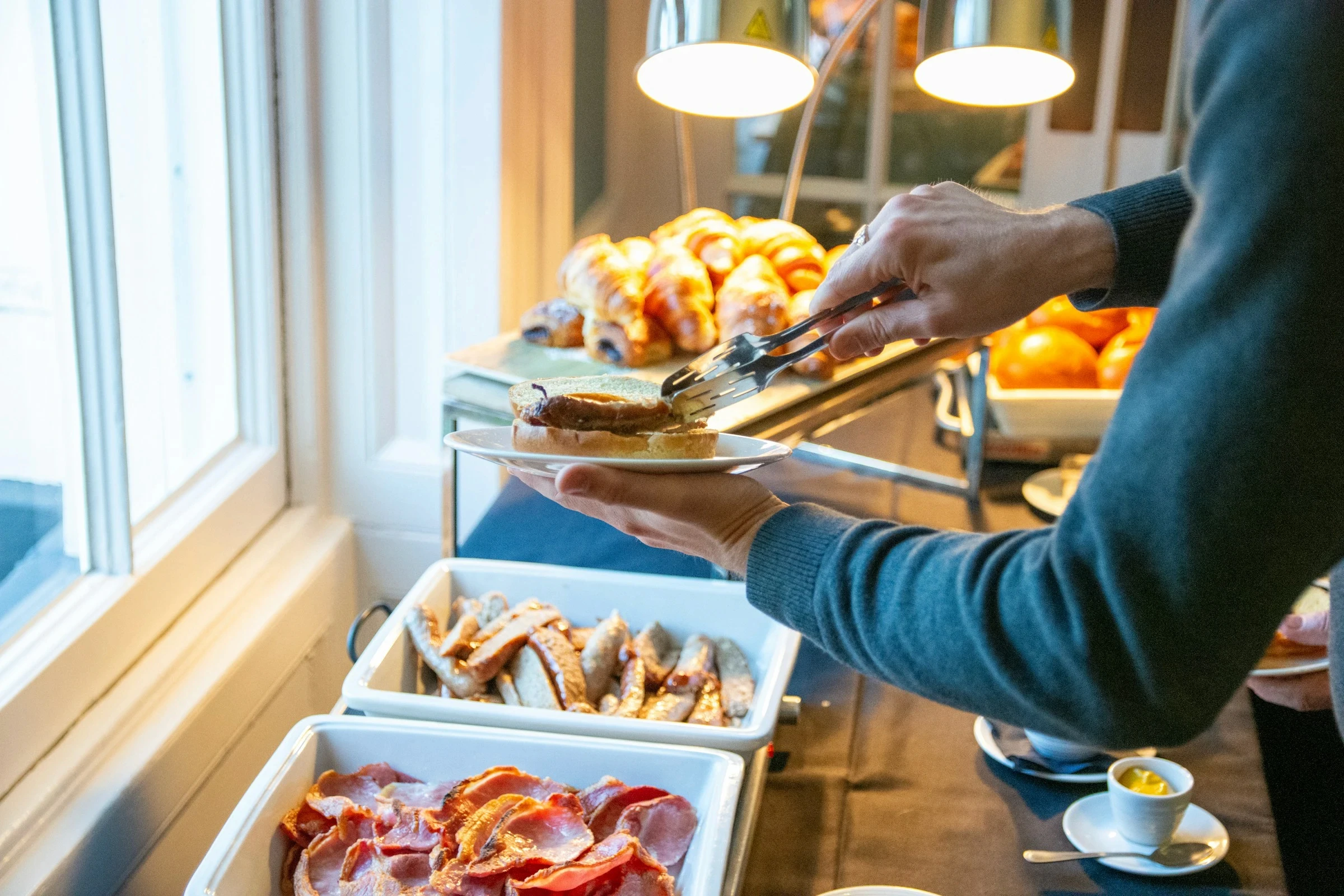
Walk into most hotel breakfast buffets forty-five minutes before closing and you’ll see the same thing: the number of guests is dwindling, some are checking out... and the trays are still full. Buffets are the single biggest source of food waste in hotels – worse than à la carte dining, room service, or banquets.¹ If you run F&B for a hotel with a buffet, you already know the feeling: you can see the waste, you just can’t say exactly how much, or which station is causing it. This guide covers what’s driving buffet waste, the operational changes that have worked at other properties, and where measurement fits into a plan that pays for itself instead of producing another report that’s tough to act on.
¹ Hotel Kitchen (American Hotel & Lodging Association, the Rockefeller Foundation, and WWF). “Prevent Waste in Serving.” Hotel Kitchen Toolkit, last updated September 26, 2024.
How do top hotels reduce food waste in their buffet operations?
Most hotels that successfully reduce buffet waste treat it as an operations problem. Here’s what they do:
They measure before they change anything. You can’t fix what you can’t see (and you need to see your waste clearly by station, by meal period, and by dish).
They set the buffet to match current demand, and are always willing to adjust.
They replenish little and often, especially toward the end of service time.
They redesign the buffet line itself. Smaller bowls, smaller plates, and smarter placement do more than most people expect.
They close the loop with the kitchen, basing next week’s prep numbers on what comes back.
None of these five steps require new equipment or a training overhaul to try. What you do need is accurate data, and someone willing and able to act on it.
Why buffets waste more food than any other service style
A buffet asks kitchens to solve an almost impossible problem: prepare enough food to make every guest feel like they arrived first, for however many guests actually show up.
That creates two opportunities for waste: First, overproduction in the kitchen, when pans get filled to look abundant rather than to match headcount. Second, during service, when guests overload their plate, because self-service portions tend to end up quite a bit larger than what people actually eat.
Across restaurants and foodservice generally, plate waste accounts for nearly 70% of all surplus food, according to ReFED, and that definition specifically includes food guests take at a buffet and don't eat, not just what a server brings out. Buffets likely sit on the high end of that number, since self-service removes the portion control a kitchen normally has.²
The average guest eats about 1.2 pounds of food per meal, per Hotel Kitchen’s research.³ Anything prepared or served beyond that, per cover, is waste.
² ReFED. “Restaurants and Foodservice.” ReFED Insights Engine — Stakeholder Recommendations.
³ Hotel Kitchen (American Hotel & Lodging Association, the Rockefeller Foundation, and WWF). “Prevent Waste By Planning.” Hotel Kitchen Toolkit, last updated September 26, 2024.
The real cost of buffet waste
For a hotel running three or four F&B outlets, edible food waste typically runs €565 to €710 a day.⁴ Multiply that across a year and you’re looking at roughly €225,000 in food that was bought, prepped, and thrown away, before you count what it costs to haul it to landfill.
Zoom out and the same math scales up. Food waste costs the global economy nearly $1 trillion a year, and food that’s grown but never eaten produces 8 to 10% of global greenhouse gas emissions, more than the entire aviation industry, according to the UN Environment Programme.⁵ For a hotel group answering to ESG targets, ownership groups, or regulators, buffet waste is one of the more concrete levers a property has to move cost and carbon at the same time.
⁴ KITRO customer data, 2026
⁵ UNEP (United Nations Environment Programme). Food Waste Index Report 2024: Think Eat Save — Tracking Progress to Halve Global Food Waste. March 2024.
Operational strategies that cut buffet waste
Before service: plan the buffet to match demand
Confirm headcount right before setup, not the night before.
Build an overage menu you can pull from instead of over-setting every dish just in case a late rush shows up.
Test smaller serving vessels for high-waste items. In our experience, Individual jars and dishes instead of large trays cut waste, without guests noticing any difference.
Keep your highest-cost items, like proteins or specialty dishes, as made-to-order or à la carte instead of sitting on the line for the full service.
During service: control what’s on the line
Use smaller chafing dishes and refill in small batches rather than keeping every tray topped to the brim.
Get banquet and culinary teams talking – a two-minute check-in on how a station is moving is often already enough.
Display food horizontally instead of piling it high. It looks just as generous and gets replenished more naturally as it’s eaten.
A simple nudge, like smaller plates, smaller serving utensils, or a sign about food waste at the buffet, measurably changes how much guests take. Both Hotel Kitchen and ReFED point to this, and we agree it’s one of the highest-return, lowest-cost changes available.
After service: learn from what comes back
Give banquet breakdown its own waste bin, separate from general trash, so the kitchen can see what didn’t get eaten.
Treat what comes back as data, not just cleanup. At Alpenhotel Ammerwald, an Austrian hotel running buffet service from breakfast through dinner, tracking data showed platters sitting out too long as each meal period wound down. Switching to smaller dishes toward the end of service fixed it, with no drop in what guests experienced at the table. That shift was part of a program that cut edible food waste by 41% and saved €87,570 a year.
Where WWF measured it directly, pairing waste separation with staff training cut waste per guest by 30%. Adding a regular audit on top of that pushed the reduction to 38%.⁶
⁶ Pearson, Pete, and Monica McBride. Hotel Kitchen: Fighting Food Waste in Hotels. World Wildlife Fund, in collaboration with the American Hotel & Lodging Association, with support from The Rockefeller Foundation, November 13, 2017.
Why measurement changes everything
Every strategy above works, but only if you know where to point it. A hotel with five buffet stations and three meal periods a day can’t guess its way to the answer. It needs to know, by dish and by service, what’s actually going in the bin.
This is usually where good intentions stall. Manual waste logging works in theory: someone weighs and records what gets thrown out. In practice, each logged entry takes at least 20 seconds, and the people closest to the bin during a Saturday brunch rush are the last people with 20 seconds to spare. Data collected this way tends to be strongest on the slowest days of the week and weakest exactly when waste is highest.
This is the gap intelligent automation was built to close. The KITRO TARE is an AI-powered camera and scale that identifies and weighs food waste automatically, the moment it happens. You place the bin on the scale, the camera captures what goes in, and the AI analyzes everything, while kitchen and stewarding teams keep working exactly as they do today. No need to hold a plate up to the camera, press any buttons, or check any screens. Because nothing changes for the team, the data holds up on the busiest service of the week, which is exactly when manual tracking usually breaks down.
That data turns into a dashboard broken down by dish, station, and meal period. Every quarter, a dedicated food waste expert reviews it with you and recommends specific, realistic next steps for your buffet.
What this looks like in practice
Hyatt
On average, each of the 30 Hyatt Hotels properties running our KITRO TARE for over a year saved €30,853 annually and cut edible food waste by 31%, with a total ROI of 365%. The operational changes KITRO kicked off made it possible.
Marriott
Seven KITRO TARE units across three Marriott International hotels saved each property €27,390 and 1096 staff hours (just from easier tracking) per year, cutting waste by 22% percent, without changing a single kitchen workflow.
TUI Blue
Twelve TUI BLUE properties ran the KITRO TARE for at least one full year. The average site cut edible food waste by 22%, saved €27,572, and got back 214 staff hours that year – a 250% ROI.
25hours
The average site across six 25hours Hotels properties measuring for over a year cut edible food waste by 31% and saved €21,760 a year, freeing up 309 staff hours, for a 327% ROI.
Pestana
A 726% ROI – that’s what the average Pestana Hotel Group property saw after a year with KITRO TARE, on top of a 47% cut in edible food waste and €42,110 in annual savings, across 7 properties.
Beyond the buffet line: donation and diversion
Even the best-run buffet produces some surplus that isn’t the result of a fixable process. That food doesn’t have to go to landfill. Nationally, less than 1% of restaurant and foodservice surplus currently gets donated, according to ReFED, mostly because prepared food is harder to transport, store, and redistribute than raw ingredients.⁷ Partnering with a local food rescue organization or an app like Too Good To Go, and composting whatever can’t be donated, closes the loop on what measurement and operational changes don’t eliminate.
⁷ ReFED. “Restaurants and Foodservice.” ReFED Insights Engine — Stakeholder Recommendations.
Frequently asked questions
How much food do hotel buffets waste?
Buffets are consistently identified as the largest source of food waste in hotels, ahead of à la carte dining, room service, and banquets, according to the American Hotel & Lodging Association’s Hotel Kitchen initiative. A hotel running three to four F&B outlets typically discards €565 to €710 in edible food a day, around €225,000 a year, much of it from buffet overproduction and plate waste.
What’s the biggest cause of food waste at a hotel buffet?
Overproduction in the kitchen and plate waste on the guest side, in roughly equal measure. Kitchens prepare to look abundant rather than to match headcount, and buffet self-service portions tend to run larger than what guests actually eat. Nationally, plate waste alone makes up close to 70% of all surplus food from restaurants and foodservice businesses, according to ReFED.
Does reducing buffet waste hurt the guest experience?
Not when it’s done well. Smaller serving vessels, horizontal food display, and refilling little and often tend to make a buffet look fresher, not sparser. Some hotels have used waste-reducing menu redesigns as a selling point with event planners rather than a compromise.
How long does it take to see a return on food waste tracking technology?
Most KITRO customers recover their full investment within six months and see a 2 to 8% reduction in annual food cost after that. Because tracking runs continuously in the background, the return compounds with every service, not just after a one-time audit.
Do you need new hardware to track buffet waste properly?
Automated systems like the KITRO TARE combine a camera and scale into a single in-bin unit, mounted on wheels so it can move between buffet stations as needed. There’s no screen to manage on the hardware itself, and TARE Setup is designed to add nothing to a kitchen team’s existing workload.
Which food waste solutions do major hotel chains use?
Hotel groups including Hyatt and Marriott use AI-powered, automated waste tracking to get service-level data on where buffet waste happens, rather than relying on manual audits or estimates. The technology varies by property, but the common thread is measurement: hotels that know where waste happens can act on it, and hotels that don’t, can’t.
Buffet waste stops being a mystery once you can see it. If you want a clearer picture of where your buffet loses food and money, that’s what the KITRO TARE is built to show you. Want to know more? Get in touch, and we’ll walk you through it!
WRITTEN BY:
KITRO
SHARE THIS: