


Insight
Comparing food waste solutions for hotels & restaurants: a buyer’s guide
Hotel and restaurant kitchens throw away food every service – and most of them have no idea how much, or why. That gap is expensive: in the US alone, food waste eats $162 billion out of restaurant profits every year, and roughly 17% of every meal served never gets eaten, according to a Georgetown University study.* Buyers evaluating a food waste tracking system today have a range of proven technology options to close that gap. The biggest difference between systems is how much manual work is required of your kitchen staff, since that directly drives adoption. Beyond that, look at how accurate and reliable the food recognition is, whether the hardware fits your kitchen’s layout and flow, and whether reporting scales across a portfolio of properties. This guide covers what to evaluate and which vendors offer these systems today.
*Georgetown University, Earth Commons Institute & Business for Impact Portion Balance Coalition, “Customizable Portions: A Cost-Conscious Approach to Reducing Plate Waste,” 2026
What to look for in a food waste tracking solution
Food waste tracking systems vary more than the marketing usually lets on. Here’s what to compare.
Measurement method and staff effort
This is the biggest functional difference between systems.
Manual entry means someone weighs and logs waste by hand – accurate only if it happens consistently, which is hard to guarantee during service. Semi-automated systems need staff to interact with the hardware, i.e., present the item for a photo before disposing of it, or confirm the category on a touch screen, which adds a short pause to what should be a fast-moving task. Fully passive systems measure waste automatically as food is discarded, with no separate step for staff to remember or perform. The less a system asks of kitchen staff, the more consistent and reliable the data is. Our complete guide to automated food waste tracking explains each type of system in more detail.
AI recognition and accuracy
An AI tracker is only as valuable as the reliability of its data. High accuracy means capturing food waste consistently in real-world kitchen conditions, without misidentifications or manual corrections.The best systems are precise enough to identify specific dishes, high-cost proteins, and edible vs. inedible food waste, while staying focused enough to keep recognition confidence high. That’s what gives your culinary and management teams clear, actionable trends they can trust.
Hardware
Kitchens are rough environments. Heat, grease, and daily use wear equipment down fast, so it needs to be heavy-duty if it’s meant to last.
Not all suppliers build to that standard. Some use kitchen-grade stainless steel that holds up for years; others use lighter materials that corrode or wear out sooner. Some add a screen for staff interaction, which is one more part that can crack or stop working over time, while screen-free designs have less to go wrong. Cleaning is worth checking too: some units sit on wheels so stewarding can move them and clean underneath without extra effort.
Reporting and scalability
A single-site dashboard is a different product than portfolio-level reporting. If you’re evaluating this for one kitchen, most systems will cover you. If you’re a multi-property hotel group or a restaurant chain in the comparison stage, ask to see the multi-site view specifically – some vendors’ idea of “multi-site” is just letting you click between separate dashboards one property at a time, with no way to compare properties or see the group as a whole. If your organization reports to regional or group leadership, confirm you can actually get that combined, group-wide view before you buy, so you can provide visibility at all levels.
Customer success model
Some vendors sell you the software and leave the rest to you: implementation, interpreting the data, deciding what to change in the kitchen. If you’re just starting out on food waste reduction, that’s often not enough. A dashboard full of numbers can be daunting when you have no guidance on what to do with them; and teams that don’t know where to start tend to lose interest fast.
Other vendors pair the hardware with a dedicated expert by default, whose only job is to help your team make sense of the data and set clear, specific actions in the kitchen. The savings still come from your kitchen team doing the work (changing prep quantity, adjusting portion sizes), but having someone guide that process makes it far more likely to succeed.
Pricing and commercial terms
None of the major vendors in this category publish list pricing, as it always depends on the number of kitchens, the hardware configuration, and the length of the contract. Ask directly (see the next section) rather than assuming cost from company size or hardware complexity.
Geographic and support footprint
A vendor’s strongest region often lines up with where its support team, technicians, and account managers are. For a group operating across several countries, or one considering expansion into a new region, it’s worth asking where a vendor’s team is staffed and how quickly they can support if hardware needs attention.
Integrations and compliance reporting
A tracking system needs to connect with your existing tools and meet rising sustainability requirements.
Menu planning, property management systems, and procurement platforms are the most common integration requests. Ask what’s live today versus what’s on a roadmap – “integration” claims vary widely in how real they are.
Food waste data is increasingly tied to sustainability reporting (like CSRD and Scope 3 emissions). Check if the platform automatically converts kitchen waste into audit-ready financial and CO₂e metrics, and whether it easily exports into your corporate reporting systems.
Questions to ask any vendor
These apply to every vendor in this category, including us. Bring them to any sales call.
Walk me through exactly what a kitchen staff member has to do every time food is discarded.
What happens if a photo or scale reading is missed – does the data gap get flagged, estimated, or just disappear?
Is the AI model pre-trained, or does it need an on-site calibration period before the data is reliable?
What’s included after setup? Is there an ongoing point of contact, or is it hardware- and software-only from month two?
Can you share a reference from a property similar in size to ours? If you’re managing multiple properties: Can I see a sample multi-site report?
What’s the typical time to payback for a kitchen our size, and what’s that estimate based on?
Can the system integrate with our existing property management or procurement software today?
How does this solution support sustainability reporting?
Where is our data hosted, and who owns it once it’s collected?
What does the contract cover (hardware, software, support) and what happens if we want to cancel or scale down?
What happens to our data, and to the hardware, if we switch vendors or end the contract?
If you’d like to start with us, our team will walk you through every question on this list.
Hospitality food waste tracking systems
These four companies are main players in food waste solutions for hotels and restaurants, but take different technical approaches. They’re listed here in the order each company was founded.
LeanPath (2004, Portland, Oregon, US)
LeanPath offers a family of systems rather than one solution. Its product line spans Floor Scale AI and Bench Scale AI, both touchless systems (though this is optional for Bench Scale) that log waste after staff has held it up or placed it to be photographed. This is supported by Scout, a more compact tier for smaller kitchens where staff tap through categories by hand.
Leanpath also includes two fully-fledged, standalone tablet-based products: Tracker Lite, which provides quick software tracking for micro-retail and satellite stations, and Snap AI, a mobile solution designed to eliminate the data blind spot at off-site catered events.
Staff effort
Bench and Floor Scale AI: Placing each item or container below the tracker before tossing.
Scout & Tracker Lite: Manual categorization; staff log each disposal by tapping options on a touchscreen interface.
Snap AI: One photo per dish; staff enter an event name and photograph leftover food at the point of service.
Hardware
Build: Floor Scale AI and Bench Scale AI are fixed floor- or bench-mounted units with a screen and camera system to capture items. Scout is a smaller, stationary unit with an integrated, lightweight physical scale and touchscreen. Tracker Lite and Snap AI are completely scale-free, software-only deployments that operate entirely on mobile tablets.
Materials: Floor Scale AI is rated IP67 (the scale) and IP65 (the touchscreen). The other solutions have no published IP rating, but we could confirm a stainless steel baseplate/countertop for both the floor and bench scale.
Scale: There are no published weight capacity or gram-level accuracy figures for Floor Scale AI, Bench Scale AI, or Scout. Tracker Lite relies entirely on manual weight entry or external data. Snap AI uses no scale at all; its proprietary computer vision calculates weight from a single image by analyzing container dimensions, food depth, and food density characteristics.
Markets
45+ countries, very US-centric
Winnow (2013, London, UK)
Winnow’s product range splits into two primary recording systems, multiple automated tiers, and a predictive forecasting web application. Its core Vision product (VisionControl, VisionAI, and VisionAI Plus, depending on the tier) is mostly to fully automated, while Winnow Track is a tablet-only option to support manual logging.
There is an add-on product called VisionPW, which uses a motion-sensor camera specifically to track post-consumer plate waste from hotel buffets or dining halls. In September 2026, Winnow also launched Winnow Foresight, a mobile-first, hardware-free production planning tool that uses AI to forecast item-level demand.
Staff effort
VisionAI, VisionAI Plus, and VisionPW: No manual input required
VisionControl: Manual validation of AI suggestions on the touchscreen interface
Track: Fully manual waste recording by tapping categories on a tablet screen
Winnow Foresight: At the end of a service, staff have to take a photo of the leftovers, so the AI can estimate the weight and predict future demand models.
Hardware
Build: The standard Vision range requires physical hardware consisting of a scale plus a pole-mounted overhead camera, equipped with a touchscreen for VisionControl or a non-touch screen for VisionAI, VisionAI Plus, and VisionPW. Track is a tablet-only setup. Winnow Foresight requires no hardware; it runs as a web-based mobile app accessible from any smartphone or tablet.
Materials: Stainless steel baseplate utilized across the standard physical scale tiers. Mobile tools (Track and Foresight) rely on client-supplied mobile devices or tablets.
Scale: Standard Vision physical scales detect physical weight in under one second. Track relies on manual weight estimation or entry. Winnow Foresight features a hardware-free predictive AI platform that pulls historical leftover data and guest occupancy numbers to forecast item-level volume. Its photographic leftover capture translates visual imagery into weight data via cloud-based computer vision.
Markets
94 countries, strong in EMEA and growing in the Middle East/APAC
Lumitics acquisition: In July 2026, Winnow officially acquired the Singapore-based food waste technology vendor Lumitics to further accelerate its footprint in APAC markets.
KITRO (2017, Zurich, Switzerland)
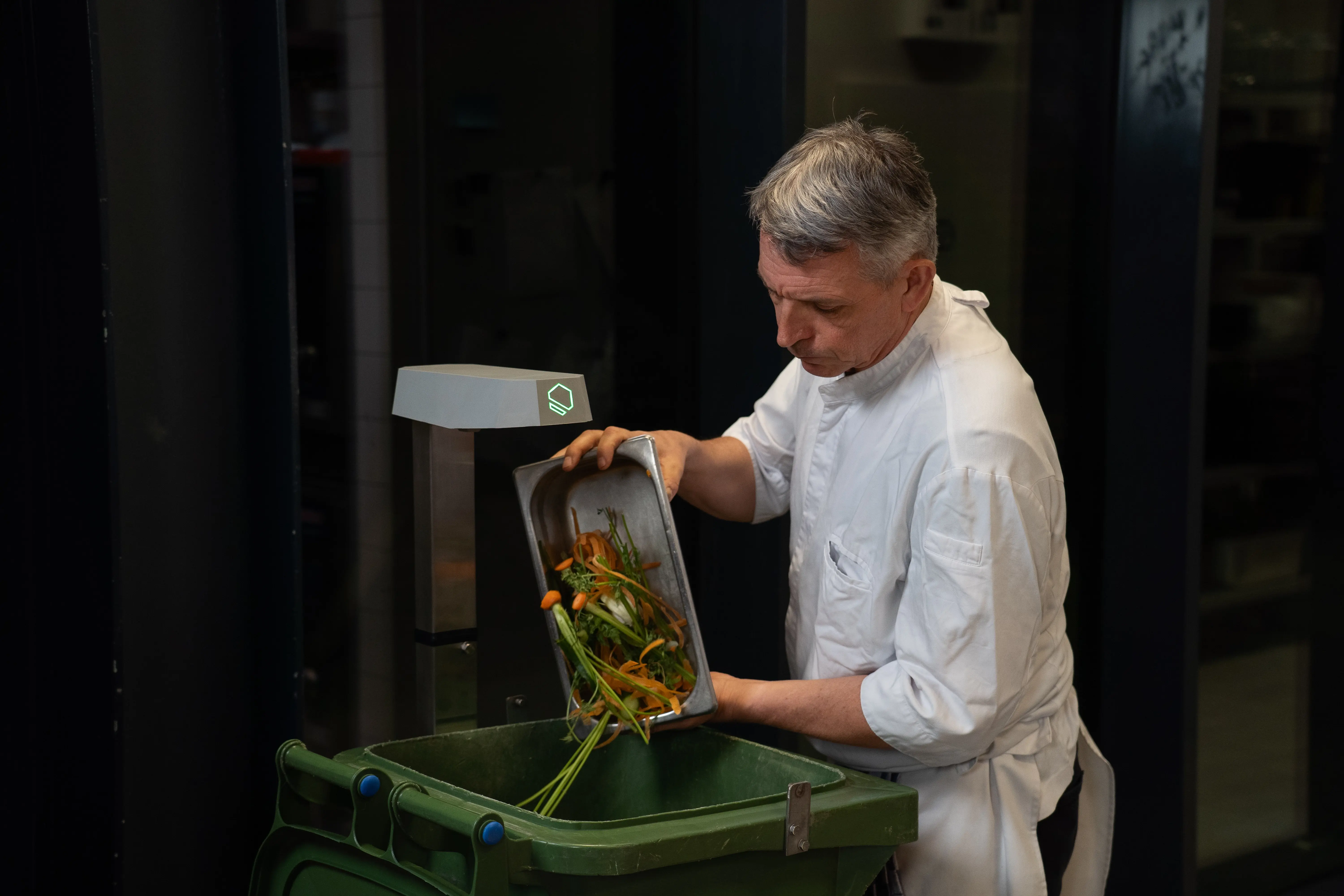
KITRO is the publisher of this guide. Its solution is the KITRO TARE, a screen-free unit with a built-in scale and an overhead camera that captures each item after it lands in the bin, so waste is logged correctly even when several items go in together.
Data flows into the My.KITRO Dashboard, with a Group view for multi-property operators and a Property view for each kitchen. It shows edible vs. inedible waste, prep waste, plate waste and spoilage, plus the cost and carbon impact of each. When the AI isn’t sure about an item, a person checks it before it enters the data, and every customer gets a dedicated food waste expert to help kitchen teams set and achieve their goals.
Staff effort
KITRO TARE: No manual input or workflow interruption – kitchen staff discard food directly into the bin as usual without needing to pause, present items to a camera, select categories, or confirm entries on a touchscreen.
Hardware
Build: Freestanding unit with a base scale that holds standard kitchen bins, an upright stainless steel column and an overhead camera. On wheels so it can be moved for cleaning. Deliberately screen-free to eliminate breakable components and operational bottlenecks. Stores data locally if the connection drops.
Materials: Fully IP20 rated with higher component ratings, made of stainless steel 304 for durability and easy cleaning in commercial kitchens. The overhead sensor unit is enclosed in heat-resistant housing (up to 90°C) designed to withstand strong kitchen heat, moisture, and high-impact environments.
Scale: Industrial single-point platform scale with an aluminium load cell, capturing weight from 10g up to 150 kg
Markets
Active in 40+ countries worldwide; strongest in EMEA, expanding in the US
Orbisk (2018, Utrecht, Netherlands)
Orbisk provides semi-automated food waste monitoring built around its Orbi device. Its solution is structured into three distinct software tiers: Insights (category-level tracking for single kitchens seeking quick wins), Excellence (ingredient-level tracking recognizing 800+ ingredients at ~90% accuracy), and Enterprise (centralized multi-property dashboards, cross-site benchmarking, and HQ administrative controls).
Orbisk’s system uses computer vision to record ingredients above the bin before they enter and mix with other waste. Because the photo is taken before disposal, staff need to pause briefly for the shot to register. The data feeds into an Action Center dashboard that correlates food waste with purchasing data, calculating financial loss and CSRD-ready carbon and water metrics.
Staff effort
Orbi (all tiers): Staff need to hold up the waste tray for image capture.
Hardware
Build: Camera mounted above bin (pole or wall-mounted), scale underneath, display screen (non-touch).
Materials: No published IP rating or material specifics
Scale: No published weight capacity, accuracy or material
Markets
Mainly Europe, expanding to the US
KITRO’s approach, in depth
We’re KITRO, and we’re one of the four systems covered in this guide. Since we know our own approach best, here’s how it maps to the criteria above.
Measurement method and staff effort
The KITRO TARE pairs a precision scale with an overhead camera, so every time food goes into the bin, the system records the weight and captures a photo at the same time. Staff don’t have to touch a screen, pose a plate for the camera, or log a category by hand. Because nothing extra is asked of the team during service, data capture is consistent and free from manual logging errors or selection bias. When the AI isn’t confident about what it’s looking at, that item is flagged and checked by a person before it enters the dataset.
That consistency has been tested independently. In a 2025 peer-reviewed study from the EU-funded LOWINFOOD project, KITRO logged every waste event across five HORECA kitchens in Germany, Switzerland and Greece.
AI recognition and accuracy
KITRO’s AI is backed by regular validation loops to ensure high data integrity. It identifies food items automatically and sorts waste by food group, ingredient, and preparation stage, separating edible waste from inedible waste and telling items apart even when several get thrown out together. New categories get added when they give kitchens something worth acting on to avoid unnecessary noise and cluttered dashboards.
Hardware
The KITRO TARE is designed specifically for demanding commercial kitchens. It is screen-free (avoiding fragile touchscreen hardware in wet, greasy, or hot environments) and accommodates standard kitchen bins. Units sit on wheels so they can be moved for cleaning. Assembly takes around 15 minutes with standard power and Wi-Fi.
Reporting and scalability
KITRO’s dashboard is built for single kitchens as well as hotel groups running many properties at once. Customers today include TUI BLUE, Hyatt, and Marriott International hotels – our case studies go into more detail on how each of them uses it.
Group View provides corporate sustainability and F&B leadership with portfolio-wide benchmarking, trends, and aggregate reporting, while our Property View lets local executive chefs and outlet managers drill down by outlet, shift, and item. Together, they deliver centralized oversight for HQ and practical, day-to-day operational visibility for individual kitchens.
And since we suggest asking every vendor to show you their different-level views, here’s where you can ask us.
Customer success model
Technology alone doesn’t change kitchen habits. Every customer is paired with a dedicated food waste expert who analyzes baseline data, conducts regular review sessions, and helps teams establish concrete reduction goals.
Teams receive structured guidance to turn raw metrics into operational routines. Customers see up to 60% less edible food waste and 2–8% annual food cost savings, with payback typically within about six months. At TUI BLUE Medina Gardens, one KITRO TARE has helped the team go even further, cutting edible food waste by 63% and saving €149,650 a year.
Pricing and commercial terms
KITRO prices on transparent subscription tiers, scaled by the number of kitchens, TARE setups, and outlets. Contracts bundle hardware access, AI processing, continuous software updates, dashboard access, and ongoing expert guidance into one annual fee, so the cost stays predictable with no hidden data or maintenance charges.
Geographic and support footprint
Headquartered in Switzerland, with team members spread out across Europe, the Middle East, and the Americas, KITRO offers multilingual customer support and expert guidance in English, German, French, and Spanish. Our onboarding, hardware logistics, and remote support are set up for multinational hospitality groups.
Integrations and compliance reporting
KITRO’s data is built to feed directly into the enterprise hospitality ecosystem. Through automated feeds and connectors – including Oracle Hospitality (OPERA Cloud & Simphony POS) for guest and cover counts, Schneider Electric platforms (Gaia for Accor, MESH for Marriott) for corporate ESG reporting, and leading F&B management systems like Birchstreet and Jomosoft – waste metrics flow straight into your existing tech stack.
KITRO converts raw food waste data into verified financial figures and Scope 3 / CSRD-aligned environmental metrics that sustainability and finance teams can carry directly into ESG and regulatory reporting without needing to transform or translate the data first.

Frequently asked questions
What’s the difference between food waste tracking solutions that use cameras vs. manual logging?
Camera-based systems identify and weigh waste automatically as it’s thrown away, while manual logging asks a staff member to weigh, categorize, and record each item by hand. Generally, camera systems produce more consistent data because they don’t depend on someone remembering to log every toss during a busy shift. Our complete guide to automated food waste tracking walks through the differences, and the other system types, in more detail.
Do food waste tracking systems require staff training?
Most require some onboarding, even for automated systems: staff need to know where the unit is and how to use it correctly. Fully passive systems like KITRO’s TARE or Winnow’s VisionAI reduce this to near zero, because staff don’t interact with the hardware at all. Tablet-based solutions like Winnow Track, or photo-triggered systems, such as LeanPath’s and Orbisk’s products, need staff to learn a short logging routine.
What’s a typical payback period for food waste tracking technology?
This varies by kitchen size and current waste levels, and how actively the team acts on the data, but vendors in this category typically cite payback periods in the range of several months to about a year. Ask each vendor what their estimate is based on for a kitchen your size.
Alpenhotel Ammerwald in Austria, for one property, saw a 1,617% ROI on its KITRO investment – an extreme case, but a sign of how fast the payoff can compound once waste patterns are identified and acted on. If you’d like a starting point for your own kitchen, our free food waste assessment is a good first step.
Are there food waste tracking solutions built for multi-site hotel groups?
Yes, all four vendors highlighted here offer portfolio-level dashboards and reporting for multi-property groups. Ask to see a multi-site report during evaluation, so you can get a feel for how easy this view makes it to compare performance across sites.
How long does it take to set up a food waste tracking system across multiple properties?
This varies a lot by vendor, and by how many sites you’re rolling out at once. Some systems are easy to install by yourself and can be running the same day; others need on-site technician visits that can turn a multi-site rollout into a months-long project.
With the KITRO TARE, for example, assembly takes about 15 minutes once it arrives, but the full process, from signed contract to your first live data, typically takes two to four weeks per site once logistics and scheduling are factored in.
Ask any vendor for both numbers: how long the physical setup takes, and how long until you’re actually seeing usable data.
Do food waste tracking systems integrate with hotel property management systems like Oracle Opera or Mews?
It depends on the vendor. Some offer native integrations with common PMS and POS platforms, while others only connect through an API or third-party middleware. Before choosing a system, confirm which platforms it works with today, and who's responsible for keeping that integration working once it's live.
Can food waste tracking systems support ESG and CSRD reporting?
Yes, but only if the system measures waste directly rather than relying on manual logs or estimates. Automated tracking makes it easier to convert kitchen data into audit-ready formats for frameworks like CSRD, GRI 306, and Scope 3 emissions reporting. When evaluating a vendor, ask whether their reports export in a format your finance or sustainability team can use without extra manual work.
What questions should I ask a food waste tracking vendor before signing a contract?
At minimum: what staff have to do during service, what happens when data is missed, what support is included after setup, and what the contract covers if you want to scale down or cancel. The full list is above.
How we put this guide together
This guide is published by KITRO. Vendors were selected based on their prominence in hospitality food waste tracking and their relevance to common buying questions hospitality teams are asking. Company information was checked against each vendor’s own published materials as of the date above. If anything here is out of date, we want to know – this page is reviewed regularly, since vendor features, funding, and milestones in this category change often.
Still deciding?
If the passive, zero-training approach described above sounds right for your kitchens, see how Marriott International properties are averaging a 22% cut in edible food waste and 101% ROI with KITRO – or explore more case studies for hotel kitchens at scale.
Not sure yet what you could save? Get a free food waste assessment. Ready to see the KITRO TARE in action? Book a demo.
WRITTEN BY:

Jessica D’Almeida
SHARE THIS:

